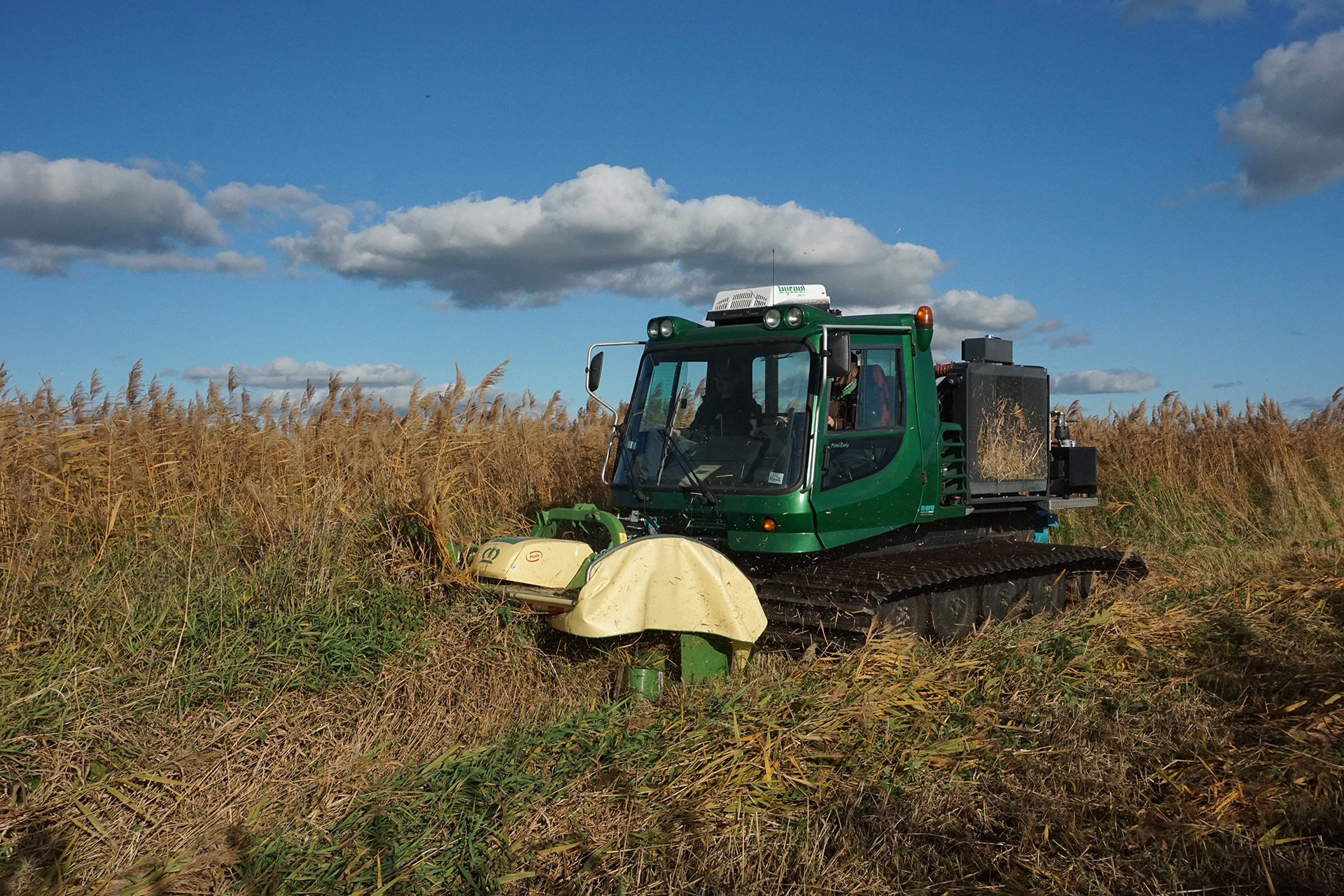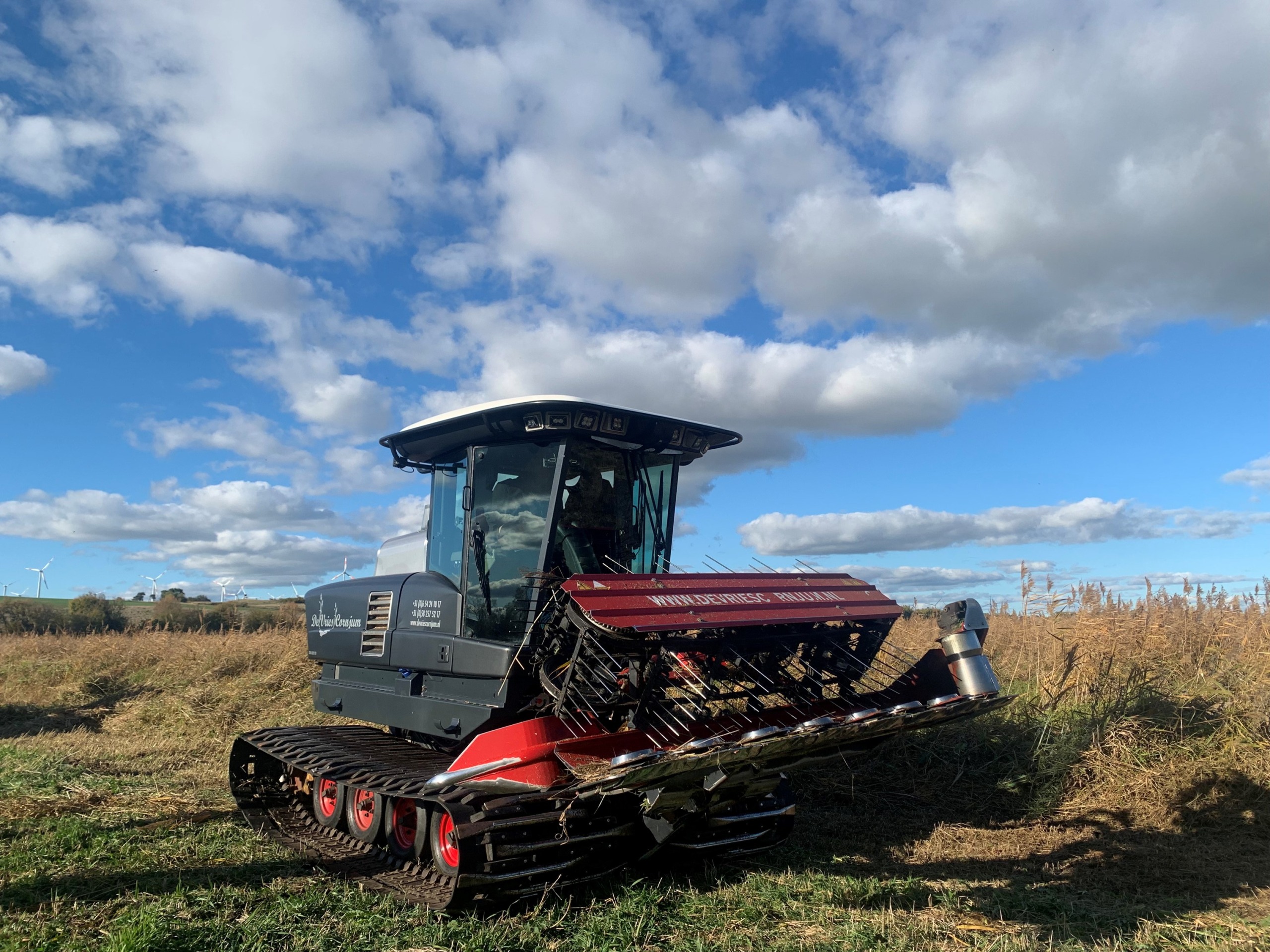
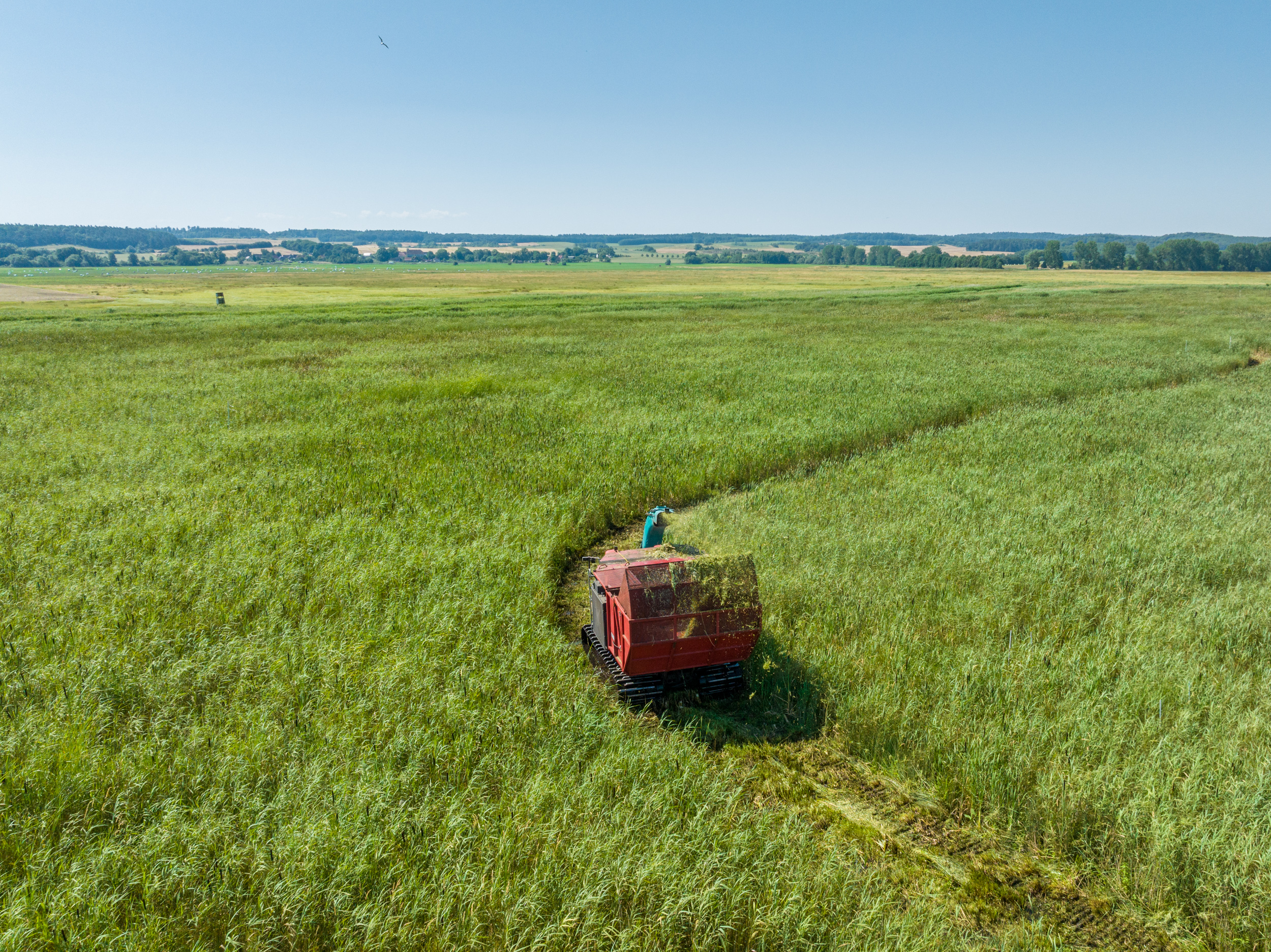
Source: Tobias Dahms
Which technique is best? – A guide to choosing the right approach for wet peatland sites
The transition to wet management is a major challenge. To prevent damage to the soil, the sward and the vegetation cover, the use of suitable technology – that is, machinery designed for managing wet peatlands – is of crucial importance. Which equipment is suitable depends on various factors, including the water level, soil properties, the size of the area, the type of management and crop, the desired area output, the budget and other site-specific characteristics. The ‘Equipment Matrix for Wet Land Management’ provides a useful initial guide.
Load-bearing capacity of peat soils: How engines put strain on the ground
When engines are used, the weight of the equipment acts directly on the ground. In terms of their driving characteristics, vegetated organic sites can be classified alongside vertically stratified soils; in the case of fens, there is a firm, root-penetrated layer on the surface, with less of the soil’s load-bearing capacity beneath it. In cropping paludiculture crops such as sphagnum mosses or cattails, there is no sward typical of grassland. The weight of the machine and the size of its contact area determine the extent to which the vertical forces from the vehicle are transferred to the ground. The mechanical load caused by vehicle traffic must be tailored to the site-specific load-bearing capacity.
Load-bearing capacity describes the soil’s ability to support the load caused by engines. Load-bearing capacity is essentially determined by the species composition of the vegetation and the condition of the ground cover, i.e. the density of vegetation. The water level, i.e. soil moisture, and the condition of the soil or the degree of degradation are further influencing factors. The mechanical load must not exceed the load-bearing capacity; otherwise, soil damage will occur, such as breaches in the ground cover or vegetation layer, or soil compaction, which can, for example, alter the vegetation. As a result, the trafficability of the (frequently) traversed areas may decrease and engines may sink into the ground.
To ensure that vehicles can travel on wet peatland sites sustainably and without causing damage, the properties of the soil and the sward, as well as the contact pressure exerted by the engine, must be considered in conjunction with one another. Key parameters for assessing the trafficability of a peatland site are the shear strength and the penetration resistance of the soil.
Source: Paul Mosebach
Shear strength and penetration resistance
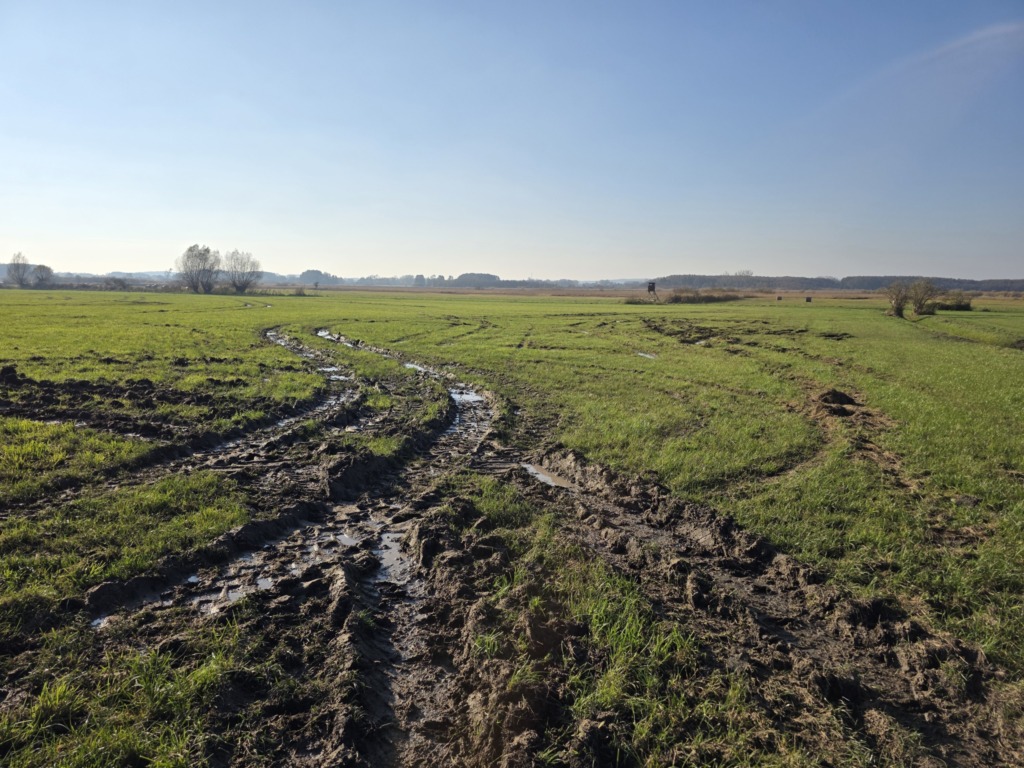
The parameters of shear strength and penetration resistance can be used to assess trafficability and to estimate the impact of vehicle traffic on the peat soil. Excessive contact pressure leads to compaction, deep ruts and the engine sinking into the ground, whilst excessive shear forces tear the vegetation cover away at the sides, thereby permanently weakening the load-bearing capacity of the peat soil.
Good to know
Shear forces arise when pressure is exerted on the ground or the sward through the vehicles’ contact patch, particularly when cornering. This results in forces acting parallel to the ground surface, which can damage the structure of the sward and the topsoil. Shear strength is measured using the shear vane and provides information on the load-bearing capacity of the sward.
Penetration resistance describes the resistance that the soil offers to a load applied to it. It depends on various physical properties of the soil, such as storage density, water content, pore size distribution and the structure of the organic matter. Penetration resistance is measured using penetrometers and provides an indication of the strength of the subsoil.
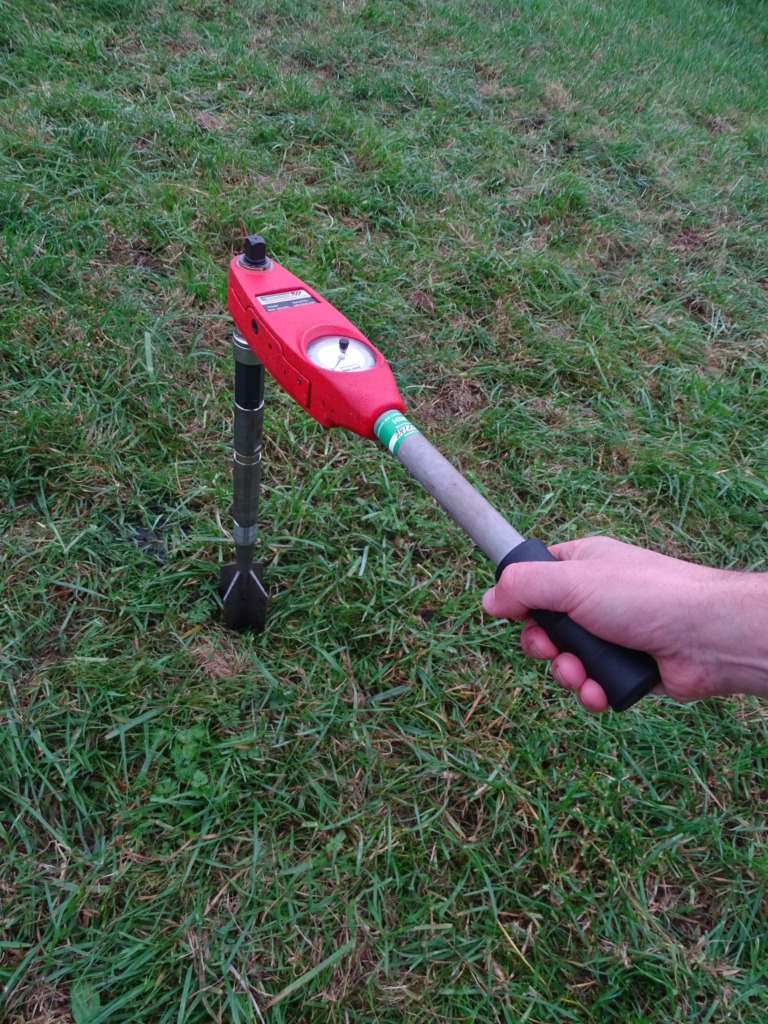
Source: Paul Mosebach
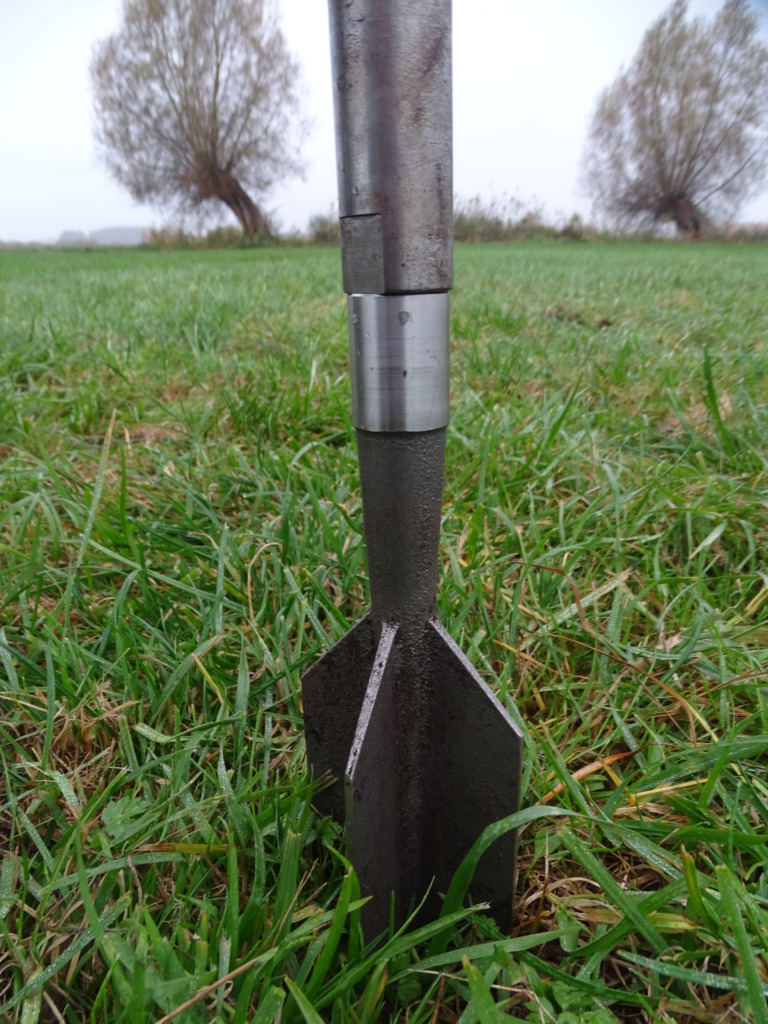
Source: Paul Mosebach
Contact pressure
Contact pressure is generated at the point of contact between the tyres or tracks and the ground. Contact pressure can be calculated for equipment carriers and trailers, including their loads. The wheel load per contact area gives the contact pressure (g/cm²).
Despite the wide range of factors that determine a machine’s suitability, contact pressure (ground pressure) is regarded as one of the most important parameters and is used as a funding threshold in many funding schemes.
Contact pressure is also a key criterion for the PaludiScout. The aim of the PaludiScout is to list machines that may be suitable for wet peatland management. For this reason, the inclusion criterion for machinery in the PaludiScout is a maximum contact pressure of 408 g/cm² for the engine, including its load (see inclusion criteria).
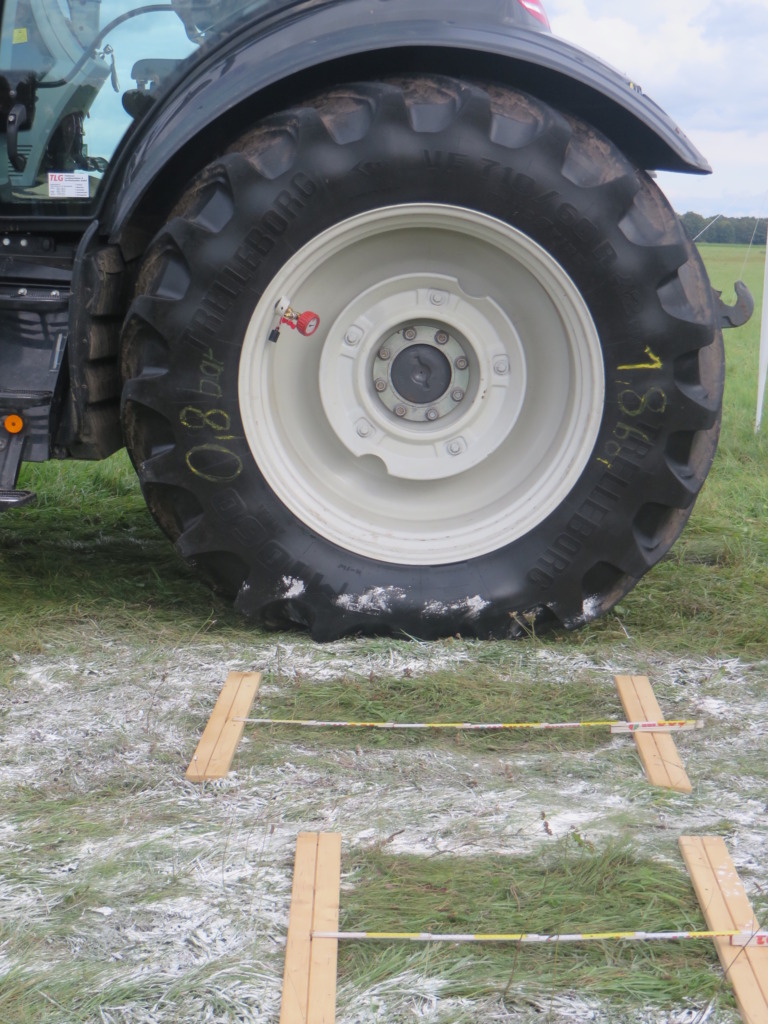
Source: Sabine Wichmann
Calculate the contact pressure yourself
There are various ways of calculating contact pressure available online. For example, the Terranimo tool offers a wide range of options. However, when it comes to assessing the load-bearing capacity of the ground, these calculators are not optimised for peatland sites.
Site-specific conditions and driving behaviour are crucial
An engine can cause damage even at low contact pressure if the shear forces are too high – for example, due to incorrect tyre pressure, excessive wheel slip, cornering at too high a speed, or attachments that are too heavy. Damage can occur even with the best machinery. Which machinery is suitable always depends on the specific ground conditions and the driving style or skills of the driver.
Easy to remember
| Strength | Direction | Resistance | Factors influencing | Damage |
| Engine pressure | Down | Penetration resistance | Machine weight and contact area vs. the ground’s load-bearing capacity | Compaction, ruts & subsidence |
| Shear force | Sideways | Shear strength of the soil | Tensile forces/slip vs. quality of the vegetation cover | Shearing the vegetation cover |
Sources and further information
[1] Wichmann, Sabine; Dettmann, Sebastian; Dahms, Tobias (2016): Agricultural technology for wet peatlands. In: Wendelin Wichtmann, Christian Schröder and Hans Joosten (eds.): Paludiculture – Management of wet peatlands. Climate protection – Biodiversity – Regional added value. Stuttgart: Schweizerbart, pp. 63–70.
[2] Wiedow, Denny; Burgstaler, Jörg; Schröder, Christian (2016): Trafficability of wet and rewetted fens. In: Wendelin Wichtmann, Christian Schröder and Hans Joosten (eds.): Paludiculture – Management of wet peatlands. Climate protection – Biodiversity – Regional added value. Stuttgart: Schweizerbart, pp. 59–63.
[3] Schröder, C.; Dahms, T.; Paulitz, J.; Wichtmann, W.; Wichmann, S. (2015): Towards large-scale paludiculture: addressing the challenges of biomass harvesting in wet and rewetted peatlands. In: MIRES AND PEAT 16 (2015), Article 13, 1–18.
[5] Mosebach, P.; Birr, F.; Wenzel, F.; Luthardt, V.; Schleip, I. (2024): Biodiversity-enhancing measures and management techniques for site-appropriate lowland moorland use. Published by the Brandenburg Ministry of Agriculture. Link: https://mleuv.brandenburg.de/sixcms/media.php/9/Standortgerechte-Niedermoorbewirtschaftung.pdf
[4] Prochnow (1999): Adapted use of lowland moorland grasslands. In: Landscape Conservation in the Nuthe-Nieplitz Lowlands, Publication Series of the Nuthe-Nieplitz-Niederung Landscape Conservation Association e.V. (Self-published, ISSN 1439-0078), 3.
[6] Brandhuber, R.; Demmel, M.; Koch, H.-J.; Brunotte, J. (2008): Soil-conserving use of agricultural machinery, DLG Fact Sheet 344, 4th edition. Link:https://www.dlg.org/fileadmin/downloads/Merkblaetter/dlg-merkblatt_344.pdf
[7] Nordt, A.; Abel, S.; Hirschelmann, S.; Lechtape, C.; Neubert, J. (2022): Guidelines for the Implementation of Paludiculture, Greifswald Peatland Centrum Publication Series (self-published, ISSN 2627‐910X), 5. Link:https://www.greifswaldmoor.de/files/dokumente/GMC%20Schriften/2022-05_Nordt%20et%20al_Paludikultur%20Leitfaden.pdf
[8] Tölle, R.; Prochnow, A.; Kraschinski, S. (2000): Measurement methods for assessing the trafficability of lowland moorland grassland. Agrartechnische Forschung (3), 6; pp. 54–61.